Qwen3 Writing Coach Benchmark for LinguaPilot AI: 4B vs 8B vs 14B with Ollama

Over the past few weeks, I built a reproducible writing coach benchmark for LinguaPilot AI.
The goal was to explore a practical question:
Can a smaller local language model provide reliable writing correction and useful explanations without requiring the largest available model?
For this first study, I compared Qwen3 4B, 8B and 14B under the same local conditions:
• 20 paired writing cases
• 60 responses generated locally
• English text correction
• Explanations requested in French
• Ollama running on Windows
• The same evaluation framework for all three models
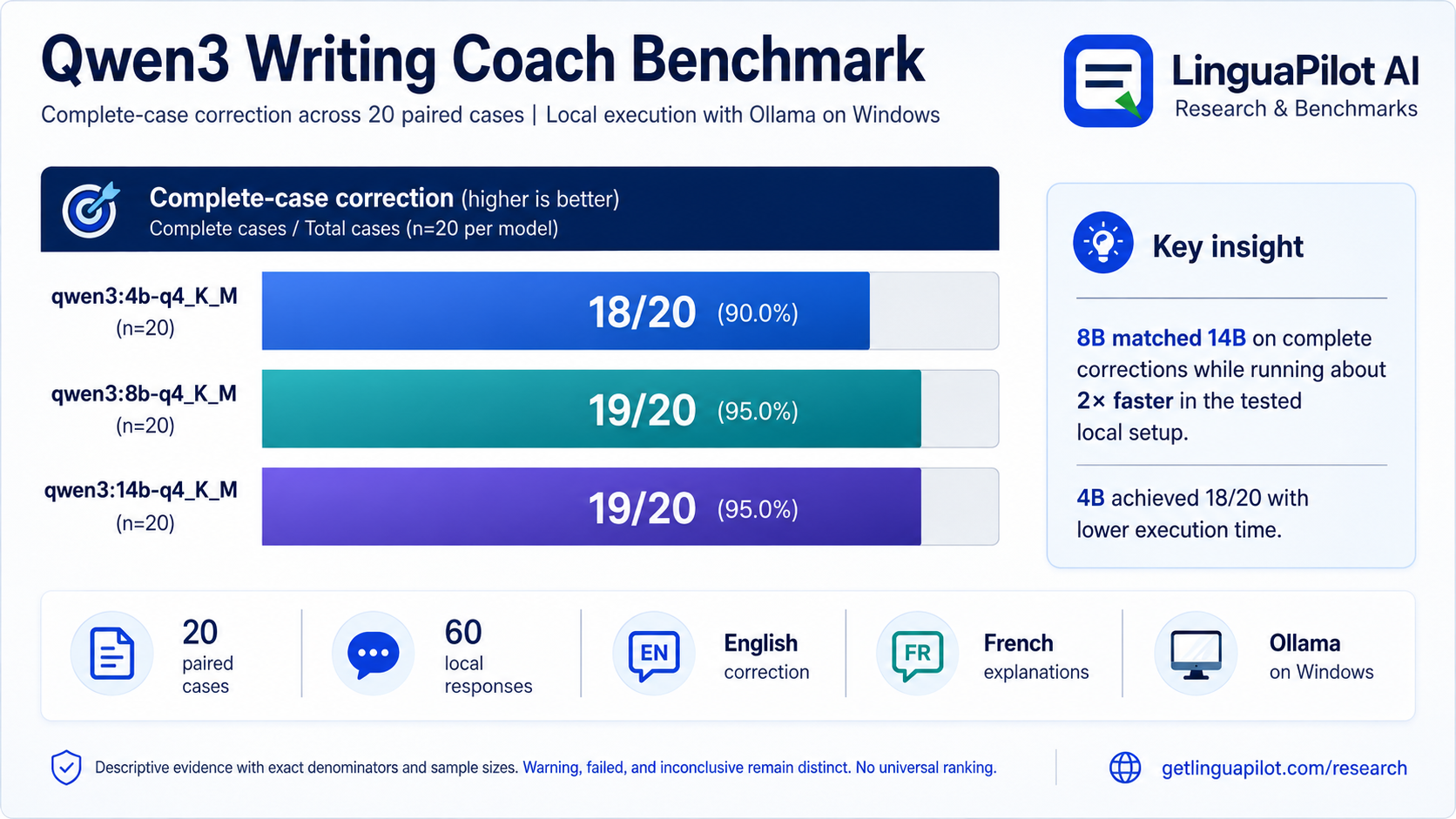
The complete-case correction results were:
• Qwen3 4B: 18/20
• Qwen3 8B: 19/20
• Qwen3 14B: 19/20
The most interesting finding was the trade-off between model size and local responsiveness.
In the tested setup, Qwen3 8B matched the 14B model on complete corrections while running approximately twice as fast. Qwen3 4B remained faster and still completed 18 of the 20 cases.
This is not intended as a universal model ranking. The results suggest that choosing a local model for writing assistance should not depend only on parameter count. Correction quality, explanation quality, response time and hardware requirements should be evaluated separately.
The complete methodology, detailed results, charts and limitations are documented as part of the LinguaPilot AI Research & Benchmarks initiative.
You can discover LinguaPilot AI here on SaaS Hive:
saashive.com/products/linguapilot-ai
For the next benchmark, what should I prioritize most: deeper explanation-quality analysis, another local model family, warm-start performance, or testing on lower-end hardware?
Comments (8)

Impressive work, Sami. And having actual numbers behind your experiment is useful.
Thanks, I really appreciate that. My goal is to keep these benchmarks practical and data-driven, so users can make better-informed choices about which local model actually fits their writing needs. More tests and comparisons are coming.

Sami, the trade-off you found between Qwen3 8B and 14B is useful on its own, most people assume bigger always wins. For the next benchmark I would prioritize warm-start performance over another model family, since a writing coach people actually keep open needs to feel fast on the second and third request, not just the first cold one.
Thanks, that’s exactly one of the findings that stood out to me as well. It’s easy to assume that a larger model will automatically perform better, but this result shows why task-specific testing matters. Warm-start performance is definitely a relevant next step for a writing coach used repeatedly during a working session, so I plan to include it in the next rounds of testing.

Wow. This is very interesting. You are taking it on a whole new level, Sami. Regarding your question. As as user, I would case about the best results and lower cost. So whichever model gives me best results and have me pay less, I would choose that one. And, as a user I would not even want to think about models. I just want the most accurate result. Selecting a model will complicate things for me. I don't know anything about these models. Especially hardware that's needed to run them :). But as a founder, I would continue experimenting with all of the mentioned parameters. Probably try with another local family model and compare its results.
Thanks, this is a very useful perspective. I agree that the end user should ideally not have to think about model names or hardware at all. The technical comparisons should happen in the background, with the goal of finding the best balance between quality, speed and cost. I’ll keep testing these trade-offs, including other local model families.

The 8B result stands out: matching the 14B model on complete corrections while responding approximately twice as fast suggests that the largest model is not automatically the most practical choice for a local writing coach.
For the next benchmark, I would prioritize deeper explanation-quality analysis. Since LinguaPilot AI is designed to help people improve their writing, a correction is only part of the value—the explanation also needs to be accurate, clear, and useful to a French-speaking learner. It would be interesting to see whether the three models differ more noticeably there than in their correction scores.
Four questions I would be interested in seeing explored:
* Do the models explain the same grammar issue consistently?
* How often do their French explanations contain inaccuracies?
* Which model gives the most actionable learning guidance?
* Does explanation quality change with more advanced writing?
Thanks — these are very relevant questions, and you’ve captured an important part of what LinguaPilot AI is meant to do. The first benchmark already included separate automated checks on the explanation fields, but deeper pedagogical quality was intentionally left for further review. Consistency, accuracy, actionable guidance and performance on more advanced writing are exactly the dimensions that would make a strong next step.
Sign in to comment or upvote.