Building an honest community around AI visibility

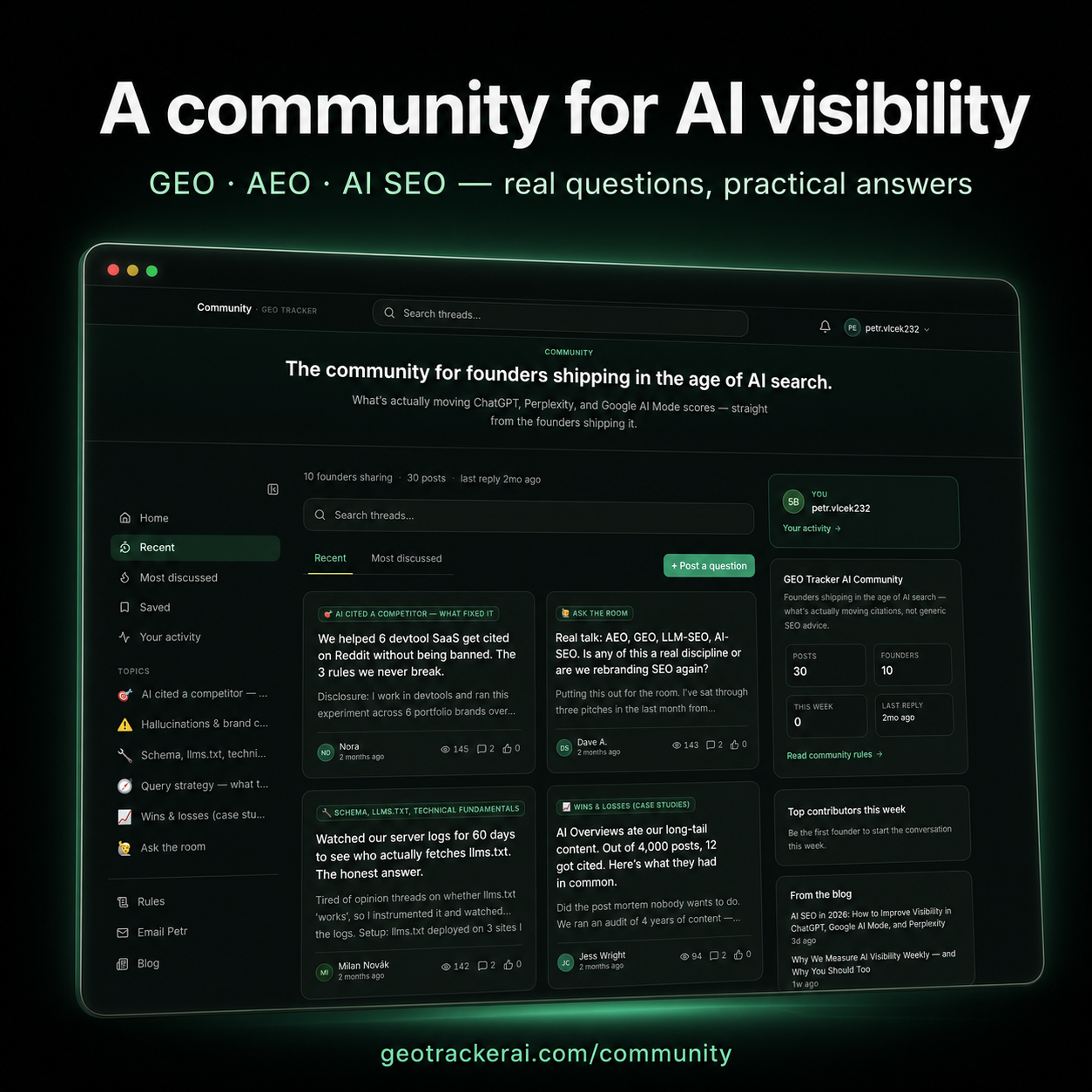
We’ve started a new community focused on AI visibility: GEO, AEO, AI SEO — call it what you like 🙂
Right now it is still new, so some topics are quite general. We’d love to make it genuinely useful by bringing in the real questions founders, marketers and SEO people are dealing with:
Why does AI recommend competitors instead of us?
Which sources influence an AI answer?
How should we measure visibility across markets and languages?
What can we actually improve after finding a gap?
Which GEO/AEO claims are useful — and which are just marketing?
This is not only for GEO Tracker AI users. You do not need to use our product at all. The goal is to discuss real problems, share practical experience, ask difficult questions and help each other make sense of a fast-moving space.
We will share what we learn while building and testing GEO Tracker AI, including where measurement is difficult or uncertain — not just the polished results.
If AI visibility matters to your product, agency or clients, you’re very welcome to join:
What is the one AI-search question you would most like to get a credible answer to?
Comments (2)

The one question I’d most want a credible answer to is: what actually causes an AI system to recommend one product or company over another?
There are already plenty of tools that can tell you whether a brand appeared in an answer, but the harder part is separating correlation from causation. If a competitor is mentioned more often, is it because of stronger third-party coverage, clearer website content, Reddit discussions, traditional SEO authority, structured data, brand popularity, or something else entirely?
I think that distinction will determine whether GEO becomes genuinely actionable or just another reporting layer. The most useful community discussions for me would be ones where people can compare experiments, show what they changed, and then see whether AI answers moved consistently afterward.
I’d also be interested in four related questions: how much AI recommendations fluctuate naturally between runs, whether optimizing for one model can hurt visibility in another, how much local market/language changes the result, and whether increased AI visibility can eventually be tied to real traffic or conversions.
Jinny, this is exactly the question that keeps me thinking and I agree that it will determine whether GEO becomes actionable or remains another reporting category.
The honest answer is that a single measurement cannot reliably prove why one product was recommended over another. AI answers fluctuate naturally, and several signals may be involved at the same time. Seeing G2, Reddit or a particular article cited alongside a competitor is useful evidence, but it is not automatically proof that this source caused the recommendation.
I think a credible workflow needs to repeat the same buyer questions, keep the model, market and language context visible, separate competitors from influencing sources, record exactly what was changed and when, and then remeasure over time. Even then, we should describe the result as directional evidence unless the change itself can be verified and alternative explanations are reasonably controlled. Otherwise, the honest conclusion is “inconclusive.”
Changes on a company’s own website — such as content, metadata, structured data or crawlability — are easier to verify. External actions such as Reddit discussions, third-party articles or directory placements are much harder to attribute confidently.
Your four additional questions are excellent. Natural run-to-run fluctuation probably needs to be the first experiment, because without understanding the baseline variance, we cannot responsibly interpret any later movement as an outcome.
I would love to turn these questions into practical community experiments: publish the setup, show what changed, repeat the measurements, and share negative or inconclusive results too. That is also the direction we are working toward with GEO Tracker AI, but I do not want to pretend that causal attribution has already been solved.
Sign in to comment or upvote.