Where FounderFlow is right now — closed-loop execution shipped, and what's next

Quick update from the build.
When we started, FounderFlow could tell you what mattered. It couldn't do anything about it. That gap is the hardest part of this category and it's where most "AI assistant" products quietly stop.
That gap just closed.
What shipped
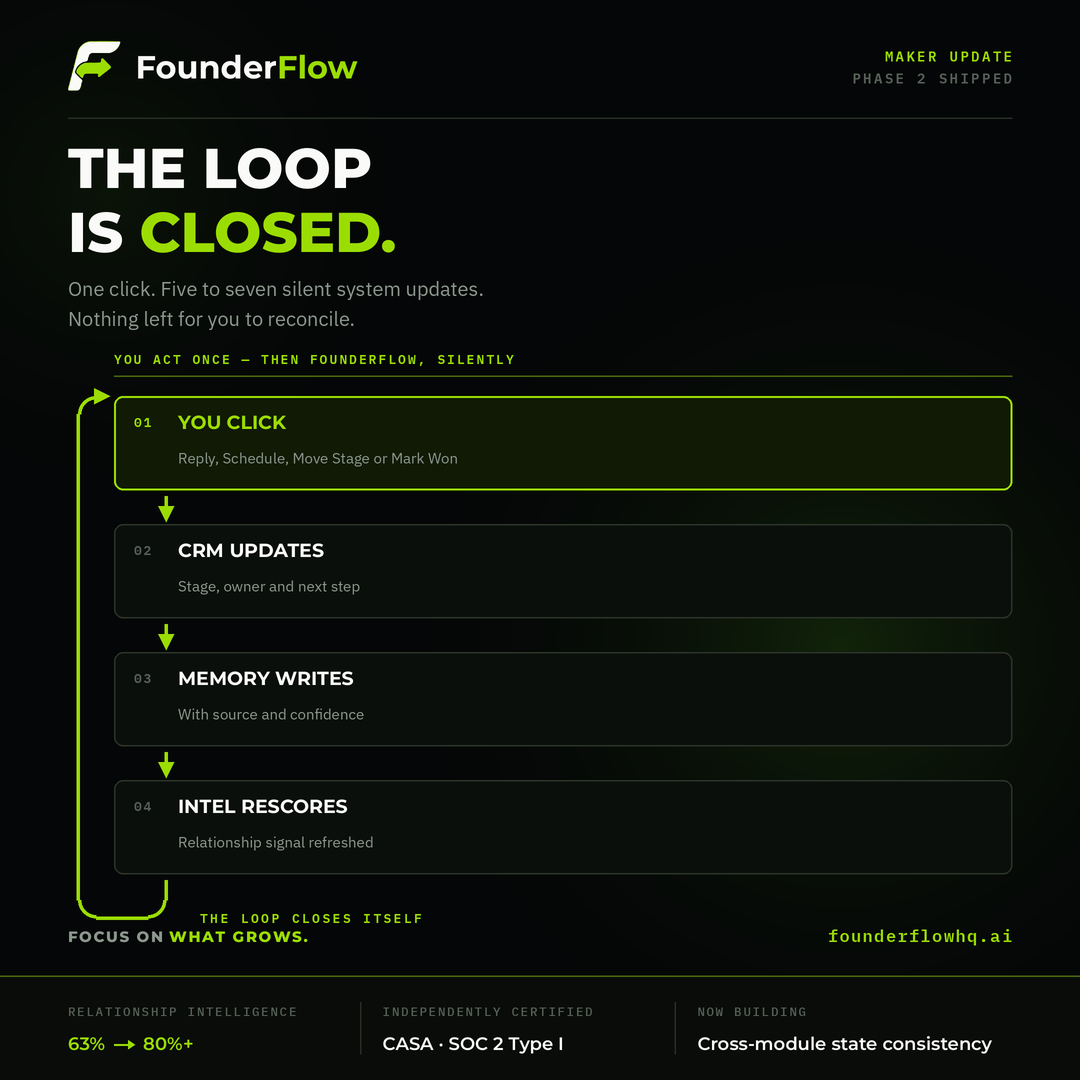
Closed-loop Pipeline execution is live. Reply, Schedule Meeting, Move Stage, Mark Won — each one now triggers a chain of silent system updates across the CRM, Executive Memory, and Relationship Intelligence. You click once. The system reconciles itself. You don't go update four places afterward, which was always the tax that made "automation" feel like more work.
Mark Won requires a confirmation step. It's irreversible, and we'd rather add one click than let the system be confidently wrong about your revenue.
What got better under the hood
Relationship Intelligence accuracy moved from the high 50s/low 60s to 80%+. That didn't come from tuning a rubric until the score looked nice — it came from an engineering audit and real fixes. Slower, less flattering, far more durable.
We also ran a head-to-head classifier benchmark and moved to Claude Haiku 4.5 after the alternative failed our thread-consistency tests. Consistency across a conversation matters more than raw speed when the output is a recommendation you're going to act on.
Trust work
CASA passed. SOC 2 Type I independently certified. For a product that sits this close to a founder's revenue, that isn't a badge — it's a precondition.
What we're building now
Cross-module state consistency. If a company shows one status in Overview and a different one in Revenue Radar, the intelligence is worthless no matter how good the model is. We've carved out a protected engineering track for it. Memory with full provenance — source, confidence, when it was first observed, why it was saved — is next.
Why any of this matters
FounderFlow is your AI Executive Chief of Staff. It watches your business, identifies what matters, protects your revenue, and tells you exactly what to do next.
The origin was a missed two-part compliance survey in one of my own businesses. $4,300 a month, twelve months, $51,600 gone. Not because I was careless — because it never surfaced.
We're building the thing that surfaces it.
7-day free trial, no credit card required — founderflowhq.ai
Would genuinely like to hear from other makers: how are you handling state consistency across modules? It's been the least glamorous and most important problem we've hit.
Comments (4)

Congratulations, Stacy 🙋🏻♂️ I am happy to hear FounderFlow is becoming better and better 👍🏻
Thank you, Sergey. 😊

This is a strong update. I like that you’re focusing on the unglamorous parts that actually determine whether an AI system feels trustworthy in day-to-day use.
The closed-loop execution piece especially stands out. Being able to take an action once and have the CRM, memory, and relationship data reconcile automatically is much more valuable than having an assistant that only tells you what to do and then leaves the cleanup to you.
The state consistency problem also feels very real. If different modules show different versions of the same customer, deal, or relationship, users start doubting everything else pretty quickly. Full provenance for memory sounds like the right next step too, especially being able to see where something came from, how confident the system is, and why it was retained.
I’d be curious how you’re deciding which module becomes the source of truth when two pieces of state conflict. I’d also love to know how often users actually notice or report those inconsistencies versus how often you catch them internally, how you handle stale memory, and whether users will eventually be able to manually override or correct system state when needed.
Jinny, you’ve zeroed in on exactly why we’ve treated state consistency as a trust problem, not just an engineering cleanup problem. Once two surfaces disagree about the same customer or opportunity, it becomes very hard to trust the recommendation sitting on top of either one.
And yes, provenance is a big part of where we’re going with memory - being able to understand the source, confidence, when something was observed, and why it was retained.
Your questions around conflict resolution, stale memory, and user correction are exactly the right ones. Some of that work is still being defined as we build out this layer, so I don’t want to pretend we’ve settled every implementation decision yet.
I’m especially curious about your last point: have you dealt with state inconsistency or stale context in a product you’re building or using? What tends to break first when it happens?
Sign in to comment or upvote.